In today’s digital world, audiences are exposed to thousands of marketing messages every single day. Scroll through LinkedIn, Instagram, or startup websites, and many brands begin to sound identical.
“We help businesses grow.”
“We provide innovative solutions.”
“We are customer-focused.”
“We deliver excellence.”
The problem is not that these statements are wrong. The problem is that they are forgettable.
Most brands fail to create a clear identity because they rely on generic messaging instead of strategic positioning. As a result, audiences struggle to remember them, trust them, or understand why they are different.
For startups, freelancers, and personal brands in Pakistan and across global markets, this creates a serious challenge. Competition is increasing rapidly, especially online. Businesses that communicate clearly and uniquely are far more likely to attract attention and build long-term trust.
This article explains why most brands sound the same, the psychology behind weak positioning, and how beginners can create stronger brand differentiation through clarity, emotional connection, and strategic messaging.
Table of Contents
ToggleSection – 02
What Does Brand Positioning Actually Mean?
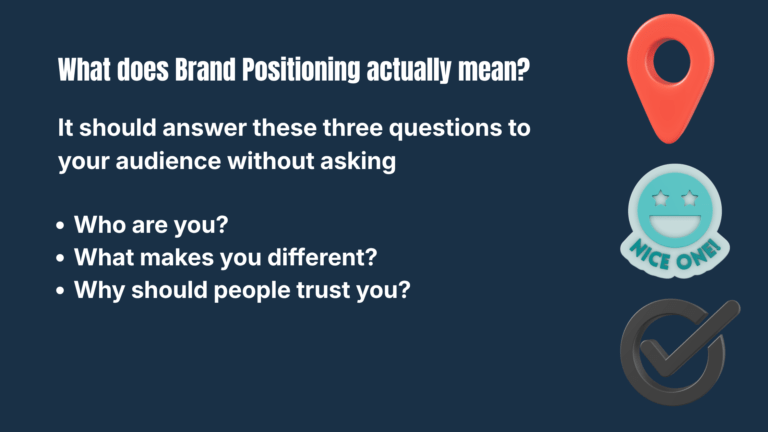
Brand positioning refers to the unique place your brand occupies in the minds of your audience.
It answers three important questions:
- Who are you?
- What makes you different?
- Why should people trust you?
Strong positioning helps people instantly understand your value.
Weak positioning creates confusion.
For example:
A generic statement like:
“We help businesses succeed.”
Could apply to almost any company.
But a clearer positioning statement, such as:
“We help Pakistani startups simplify their brand messaging using psychology-driven content strategies.”
Feels more memorable and specific.
That specificity creates stronger audience trust.
Related: Brand Positioning for Beginners (A guide for your Startup)
Section – 03
Why Most Brands Sound Identical
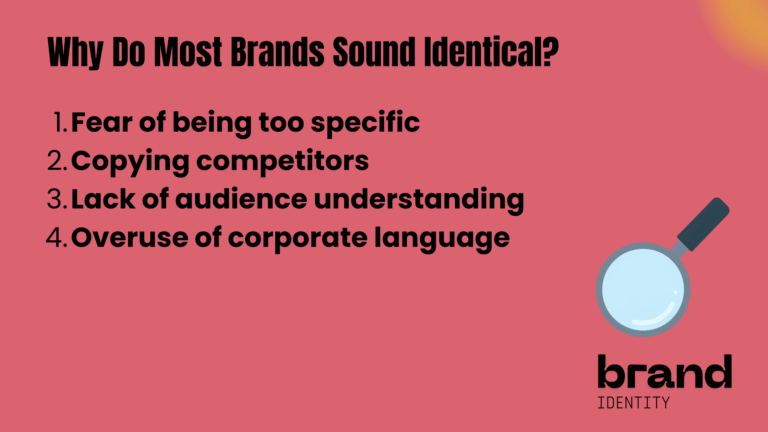
1. Fear of Being Too Specific
Many businesses try to appeal to everyone.
They believe broader messaging attracts more customers. In reality, the opposite usually happens.
When messaging becomes too broad:
- emotional connection weakens,
- trust decreases,
- and audience clarity disappears.
Specific brands feel more confident and credible.
For example:
A personal brand focused on “content writing” may struggle to stand out.
But positioning around:
“SEO-focused storytelling for startup founders.”
Creates a more defined identity.
2. Copying Competitors
Many startups study successful competitors and unintentionally imitate their language.
This creates an industry-wide cycle where brands repeat the same phrases:
- innovative solutions
- customer-centric approach
- results-driven strategy
- quality service
Eventually, audiences stop noticing these claims because they no longer feel meaningful.
Strong positioning requires original perspective, not recycled wording.
3. Lack of Audience Understanding
Effective positioning begins with understanding people deeply.
Many brands focus too heavily on features while ignoring:
- audience emotions,
- fears,
- frustrations,
- and identity.
Research in consumer psychology consistently shows that emotional trust strongly influences buying behavior.
People often choose brands that make them feel:
- understood,
- safe,
- confident,
- or connected.
Without emotional relevance, messaging becomes generic.
4. Overuse of Corporate Language
One major reason brands sound the same is excessive corporate jargon.
Words like:
- scalable,
- synergy,
- optimization,
- disruptive,
- innovative,
Often reduce clarity rather than improve it.
Modern audiences prefer:
- conversational language,
- authenticity,
- and practical communication.
Especially in Pakistan’s growing startup ecosystem, audiences increasingly trust brands that sound human rather than overly corporate.
Section – 04
The Hidden Cost of Generic Brand Messaging
Weak positioning affects more than branding.
It impacts:
- customer trust,
- SEO performance,
- social engagement,
- and conversion rates.
When users cannot quickly understand your brand:
- they leave websites faster,
- ignore content,
- and forget your message.
According to multiple global marketing studies, brands with clear differentiation are significantly more likely to improve customer recall and long-term loyalty.
Google also rewards websites that demonstrate:
- expertise,
- consistency,
- topical relevance,
- and helpful content.
This aligns directly with Google’s E-E-A-T principles:
- Experience
- Expertise
- Authoritativeness
- Trustworthiness
Strong positioning improves both user experience and SEO clarity.
Related: Learn how to fix your brand messaging using emotional psychology
Section – 05
Real Brand Case Study: Apple
Apple is one of the strongest examples of successful brand positioning.
Apple does not market itself only as a technology company.
Its messaging consistently focuses on:
- simplicity,
- creativity,
- premium experience,
- and innovation.
Even its product launches, website copy, and visual identity reinforce the same emotional positioning.
While competitors often emphasize technical specifications, Apple emphasizes user experience and emotional identity.
This consistency helps customers instantly recognize the brand.
The lesson for beginners is important:
Strong positioning is not about sounding smarter. It is about sounding clearer and more meaningful.
Section – 06
How to Fix Your Brand Positioning
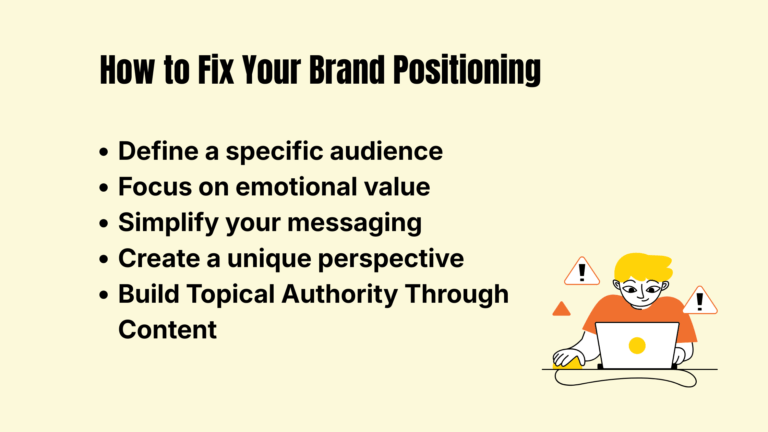
1. Define a Specific Audience
Avoid trying to serve everyone.
Instead, clearly identify:
- who you help,
- what problem you solve,
- and what type of people benefit most from your expertise.
For example:
Instead of:
“I help businesses with marketing.”
Use:
“I help educational startups improve their SEO content strategy.”
Specific positioning builds trust faster.
2. Focus on Emotional Value
Most brands explain what they do.
Very few explain how they improve people’s lives emotionally.
Ask:
- What fear does my audience have?
- What emotional outcome are they seeking?
- What feeling should people associate with my brand?
For example:
A financial brand may position itself around:
- security,
- clarity,
- and confidence.
Not simply “financial services.”
3. Simplify Your Messaging
Clear communication outperforms complicated language.
If a beginner cannot understand your brand message within seconds, your positioning likely needs improvement.
Strong messaging should feel:
- simple,
- direct,
- and memorable.
4. Create a Unique Perspective
Many successful brands stand out because they communicate a strong point of view.
For example:
Instead of saying:
“Content marketing is important.”
You could say:
“Most startup content fails because it lacks emotional clarity.”
That perspective creates differentiation.
5. Build Topical Authority Through Content
Positioning becomes stronger when supported by consistent educational content.
Publishing content around:
- brand messaging,
- SEO strategy,
- emotional branding,
- buyer psychology,
- and startup communication
Helps both audiences and search engines understand your expertise.
This improves:
- authority,
- trust,
- and organic visibility.
Section – 07
Why Brand Positioning Matters in Pakistan
Pakistan’s digital economy is expanding rapidly.
Freelancers, startups, educational platforms, and personal brands are entering competitive online markets every year.
However, many local businesses still use:
- copied messaging,
- generic social media content,
- and unclear brand communication.
This creates a major opportunity.
Brands that focus on:
- clarity,
- educational content,
- emotional connection,
- and audience trust
Can stand out more easily even with smaller budgets.
Founder-led branding is also growing strongly on LinkedIn and content platforms.
People increasingly trust individuals and brands that communicate authentic expertise instead of polished corporate language.
Section – 08
FAQ Section
Why do many brands sound the same?
Many brands use generic messaging, copy competitors, and avoid specific positioning. This reduces uniqueness and audience trust.
What is the biggest mistake in brand positioning?
The biggest mistake is trying to target everyone instead of focusing on a specific audience and a unique value.
How can startups improve brand positioning?
Startups can improve positioning by simplifying messaging, understanding audience psychology, and consistently publishing educational content.
Does brand positioning affect SEO?
Yes. Clear positioning improves topical authority, content relevance, user engagement, and overall search visibility.
Why is emotional branding important?
Emotional branding helps audiences feel connected, understood, and confident in a brand, which increases trust and loyalty.
Can personal brands use positioning strategies?
Absolutely. Personal brands use positioning to communicate expertise, personality, and unique perspective more effectively.
Conclusion
Most brands sound the same because they prioritize broad messaging over meaningful differentiation.
In highly competitive markets, generic communication no longer works. Audiences want brands that feel clear, trustworthy, emotionally relevant, and authentic.
For beginners, startups, and personal brands in Pakistan and globally, strong positioning creates a major competitive advantage. It helps people understand your value faster, remember your message longer, and trust your expertise more deeply.
The future of branding is becoming increasingly human-centered. Brands that combine:
- clarity,
- emotional intelligence,
- educational value,
- and consistent communication
Will continue to outperform competitors in both SEO and audience trust.
Instead of trying to sound bigger, smarter, or more corporate, focus on becoming clearer and more specific.
That is what truly makes a brand memorable—a strange concept on the internet, where half the businesses still introduce themselves like malfunctioning PowerPoint presentations.
Pingback: Brand Messaging vs Brand Positioning: Key DifferencesBrand Messaging vs Brand Positioning: Key Differences - The Brand Clarity Guide