
Most brand messaging advice tells you to “focus on pain points.”
So brands do exactly that:
- “Struggling to grow?”
- “Tired of low engagement?”
- “Frustrated with results?”
And yet… nothing changes.
Because the problem isn’t that brands ignore pain points.
It’s that they oversimplify them.
This is where emotional granularity changes everything.
Instead of labeling emotions broadly, emotional granularity helps you identify and communicate specific, nuanced feelings your audience experiences.
And that difference?
It’s what turns generic messaging into something people actually connect with.
Table of Contents
ToggleSection – 02
What Is Emotional Granularity?
Emotional granularity is a concept from psychology that refers to the ability to identify and describe emotions with precision.
Instead of saying:
- “I feel bad”
A person with high emotional granularity might say:
- “I feel anxious about uncertainty”
- “I feel frustrated because I’m not seeing progress”
In brand messaging, this means moving beyond vague emotional labels and addressing real, specific experiences.
Section – 03
Why Generic Pain Points Don’t Work Anymore
Let’s be honest.
Your audience has seen every version of:
- “Are you struggling?”
- “Do you feel stuck?”
These statements are:
- overused
- emotionally flat
- easy to ignore
What happens when messaging is vague:
- It doesn’t feel personal
- It fails to trigger emotional recognition
- It reduces trust
People don’t respond to generic pain.
They respond to recognized experiences.
Related: Mirror Neurons in Brand Messaging
Section – 04
The Science Behind Emotional Precision
Research in psychology shows that people who can identify emotions more precisely:
- regulate emotions better
- respond more effectively
- feel more understood
When applied to messaging:
- Specific emotions create stronger resonance
- Clear emotional language improves recall
- Precision builds credibility
In simple terms:
The more accurately you describe how someone feels, the more they trust you understand them.
Section – 05
Emotional Granularity vs Traditional Pain Points
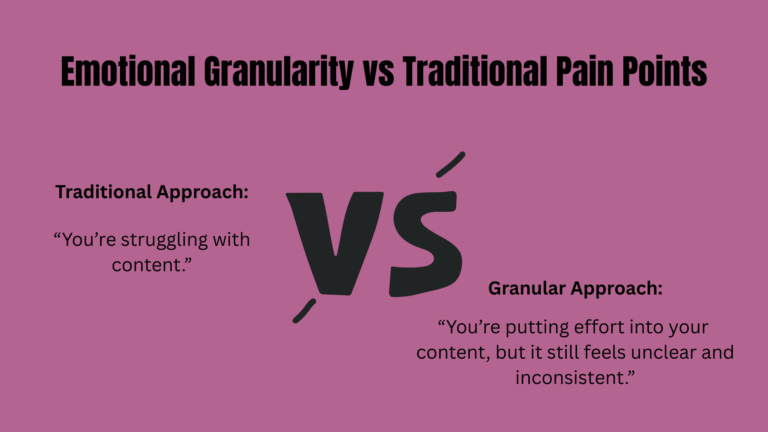
Traditional Approach:
“You’re struggling with content.”
Granular Approach:
“You’re putting effort into your content, but it still feels unclear and inconsistent.”
See the difference?
One labels the problem.
The other reflects the experience.
Section – 06
Why This Matters for Educational Platforms
In Pakistan and across global audiences, learners face layered emotional challenges:
- confusion about direction
- fear of wasting time
- self-doubt about abilities
- pressure to succeed
Generic messaging misses this complexity.
Granular messaging helps:
- build relatability across diverse audiences
- simplify complex emotional states
- create trust faster
For educational brands, this directly impacts:
- course enrollment
- engagement
- long-term loyalty
Section – 07
Case Study: Nike’s Emotionally Precise Messaging
Nike doesn’t just say:
“Achieve your goals.”
It taps into specific emotional states:
- self-doubt
- pressure
- resilience
Campaigns often reflect internal struggles like:
- “You’re not fast enough”
- “You’re not strong enough”
Then reframes them.
Why this works:
- It acknowledges real internal dialogue
- It mirrors the audience’s thoughts
- It creates emotional alignment
Nike’s messaging feels personal because it is emotionally specific, not generic.
Related: Cognitive Load in Brand Messaging
Section – 08
How to Apply Emotional Granularity in Brand Messaging
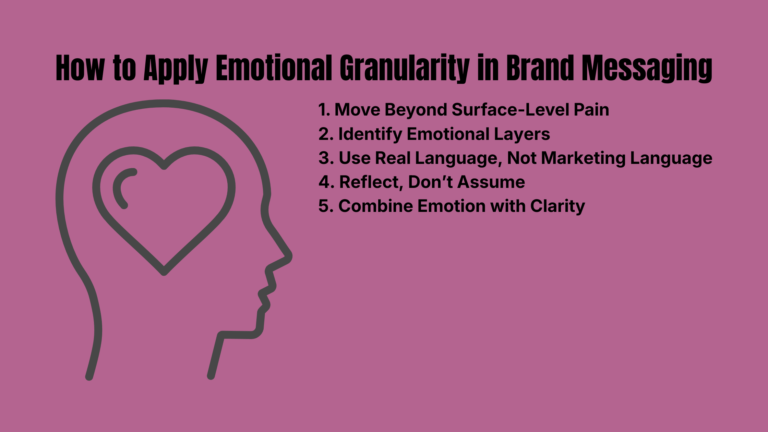
1. Move Beyond Surface-Level Pain
Don’t stop at:
- “Low engagement.”
Ask:
- Why does that matter to them?
- What does that feel like?
2. Identify Emotional Layers
Every problem has layers:
Example:
- Surface: low conversions
- Deeper: frustration
- Core: self-doubt or confusion
Speak to the deeper layer.
3. Use Real Language, Not Marketing Language
Avoid:
- “optimize performance”
- “maximize growth potential”
Use:
- “Your content feels like it’s not working.”
- “You’re unsure what to say next.”
4. Reflect, Don’t Assume
Your messaging should feel like:
“You understand me.”
Not:
“You’re guessing.”
5. Combine Emotion with Clarity
Emotional messaging should still be:
- simple
- structured
- easy to understand
Too much emotion without clarity creates confusion.
Section – 09
Data-Driven Insight: Emotional Messaging Drives Engagement
Marketing and behavioral studies show:
- Emotionally specific messaging improves engagement
- Content that reflects real experiences increases retention
- Personalized emotional language builds stronger trust
For educational platforms, this means:
- higher student engagement
- improved learning outcomes
- stronger brand connection
Section – 10
Content Strategy for Pakistan & Global Audience

1. Keep Language Simple
Use clear English that works across:
- local audiences
- international readers
2. Use Contextual Examples
Relate messaging to:
- career growth
- skill development
- real-life challenges
3. Build Trust Through Accuracy
Support emotional insights with:
- real scenarios
- examples
- structured explanations
This aligns with Google’s E-E-A-T principles.
Section – 11
People Also Ask (FAQs)
What is emotional granularity in marketing?
Emotional granularity in marketing refers to identifying and communicating specific emotions rather than using broad or generic labels.
Why are pain points not enough in messaging?
Because generic pain points fail to create emotional connection and often feel repetitive or impersonal.
How does emotional granularity improve conversions?
It builds trust by making the audience feel understood, which increases engagement and decision-making.
Can emotional messaging improve SEO?
Yes. It increases user engagement, time on page, and interaction, which are important SEO signals.
What industries benefit from emotional granularity?
All industries benefit, especially education, coaching, and service-based businesses.
How do I identify my audience’s real emotions?
Through research, feedback, and observing how your audience describes their challenges.
Conclusion: Precision Builds Connection
The future of brand messaging is not louder claims or broader statements.
It’s precision.
Emotional granularity allows you to:
- move beyond generic messaging
- connect on a deeper level
- build trust faster
For educational platforms in Pakistan and beyond, this is a powerful advantage.
Because when your audience feels understood,
they don’t just read your content.
They believe it.
And that belief is what drives action.
Pingback: Mirror Neurons in Brand Messaging: Stories Build Trust - The Brand Clarity GuideMirror Neurons in Brand Messaging: Stories Build Trust
Pingback: Cognitive Load in Brand Messaging: Why Simplicity Wins
Pingback: Emotional Branding: Why People Trust Some Brands Instantly - The Brand Clarity Guide