If you’ve ever copied a “viral” LinkedIn post format and felt like a stranger wearing your own name, you already know the real problem with personal branding advice. Most of it teaches you to perform, not to be findable, trusted, and unmistakably you.
This guide breaks that pattern with a 30-day, week-by-week system grounded in how platforms actually reward content in 2026, backed by real engagement data, and built around one idea: authenticity isn’t a vibe, it’s a structure. Once you build the structure, the “feeling authentic” part takes care of itself. It’s written for founders, freelancers, and students in Pakistan building a name online — but it holds up anywhere.
Table of Contents
ToggleSection 02
Why Most Personal Branding Advice Fails in the First Week
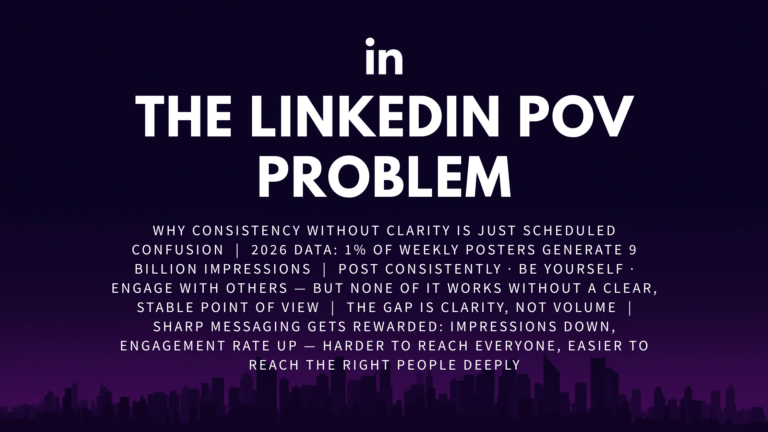
The typical advice goes: post consistently, be yourself, engage with others. It’s not wrong, just incomplete. It skips the one thing that determines whether the effort compounds: a clear, stable point of view.
Without a point of view, consistency just means posting the same confusion on a schedule. Engagement becomes generic (“Great post! “) because there’s nothing specific to respond to.
Recent platform data backs this up. According to a 2026 industry study, only about 1% of LinkedIn users post weekly, yet that small group generates roughly 9 billion impressions every week. The gap isn’t volume; it’s clarity. A small number of people figured out what they stand for, and the platform rewards that disproportionately.
There’s also a structural shift worth understanding before you start posting. Newer engagement data shows a recent drop in overall impressions paired with a meaningful rise in engagement rate. This suggests that platforms are becoming more selective about whose content gets surfaced. In plain terms: it’s getting harder to get seen by everyone, and easier to get seen deeply by the right people — if your message is sharp enough to earn it.
Section 03
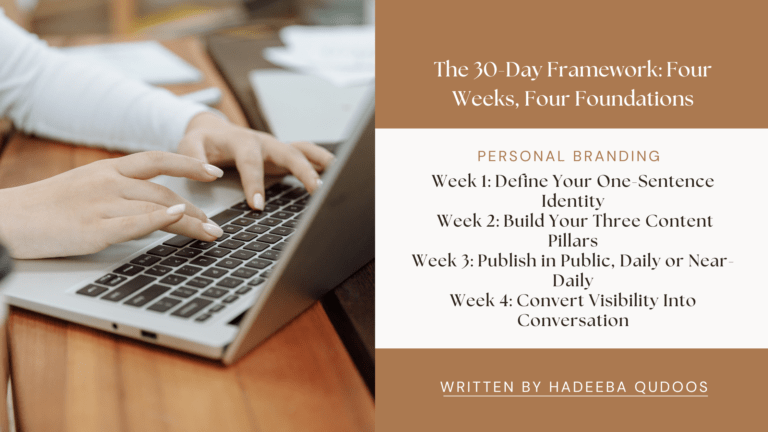
The 30-Day Framework: Four Weeks, Four Foundations
Think of this less like a content calendar and more like construction. Each week builds on the last. Skipping a week doesn’t save time — it just means you’re decorating a house with no foundation.
Week 1: Define Your One-Sentence Identity
Before writing a single post, answer this: if a stranger read one sentence about you, what should they understand and remember?
This isn’t your job title. “Content writer” tells people what you do, not why it matters or who it’s for. A real identity sentence has three parts: who you help, what specific problem you solve, and what makes your approach different.
A weak version: “I help businesses with marketing.”
A strong version: “I help founders turn confusing messaging into a story their customers can repeat back.”
Spend this week writing and rewriting that sentence. Test it on three or four people who don’t know your work well. If they can repeat it back accurately after hearing it once, it’s ready.
Week 2: Build Your Three Content Pillars
Authentic doesn’t mean random. It means consistently specific. Pick three pillars — recurring themes your content will live inside — that connect directly to your one-sentence identity.
Someone positioning around brand clarity might choose: real client messaging mistakes (with the lesson, not the client’s name), behind-the-scenes thinking on how positioning gets built, and commentary on why most marketing advice misses the real problem.
Three pillars give you range without losing focus. Your audience starts recognizing your “type” of post before they finish the first line — that recognition is what authenticity looks like from the outside.
This week, also separate your platforms by job: LinkedIn for professional credibility and inbound leads, Instagram or Facebook for the behind-the-scenes layer, X for fast, opinionated takes. The pillars stay the same; the tone adjusts per platform.
Week 3: Publish in Public, Daily or Near-Daily
This is the week most people quietly skip, because publishing before you feel “ready” is uncomfortable. Do it anyway — authenticity is mostly reps, not talent.
Current platform benchmarks give a useful target. A 2026 LinkedIn engagement study found individual creators see the strongest results posting three to five times per week, with comments and reshares mattering more than sheer volume — a sustainable cadence, not the burnout-inducing “post twice a day” advice.
Format matters as much as frequency. One 2026 analysis found personal stories generate roughly five times more engagement than company-style updates, and posts in the 1,200 to 1,500 character range with three to five relevant hashtags tend to perform best. A real story, told at a readable length, beats a polished announcement almost every time.
If you’re early-stage with a small following, take heart: smaller accounts are currently the fastest-growing segment. One 2026 study found accounts in the 2,000 to 10,000 follower range growing fastest, while large “big brand” accounts barely grow 1%, as audiences seek niche voices over polished, oversized accounts. You’re not behind — you’re in the segment the algorithm currently favors.
Week 4: Convert Visibility Into Conversation
By week four, you should have a recognizable identity sentence, three content pillars in motion, and roughly three weeks of consistent publishing behind you. Now shift focus from being seen to being engaged with directly.
Add a simple, repeatable call-to-action inside your content — a keyword comment, a DM trigger, a link to a deeper resource. The goal isn’t a hard sell; it’s giving an interested reader an obvious next step.
This is also the week to notice which pillar got the strongest response. That data point should shape weeks five through eight far more than guessing ever could.
Section 04
Real Brand Case Study: How Duolingo Turned Personality Into Authority
Personal branding principles scale, and a useful proof point is a brand that built a “personal” identity inside a corporate one.
Duolingo’s owl mascot, Duo, started as a simple app icon. The shift happened when Duolingo’s social team stopped posting like a corporation. And started posting like a specific, opinionated character, giving a young social media manager creative control to make the mascot behave in unexpected, unpolished ways on TikTok.
The results weren’t accidental. A single TikTok featuring Duo joking about mascots scored over 602,000 engagements at a 21.5% engagement rate, far above typical industry averages. A separate meme tied to language-learning themes reached 8.5 million views and 1.54 million engagements, nearly four times the average rate.
The lesson for a founder and a personal brand owner is direct: Duolingo didn’t win by being louder; it won by being specific and consistently recognizable across every post. Their storytelling brought them to the point where audiences could predict their voice before reading the caption. That’s the target for your own personal brand: recognizability before name recognition.
Section 05
E-E-A-T: Why Trust Signals Matter More Than Aesthetics
Google’s E-E-A-T framework (Experience, Expertise, Authoritativeness, Trustworthiness) applies to personal brands just as much as web pages, because the underlying question is the same: can this source be trusted?
For an individual, that translates into three habits worth building into your 30 days. Share your personal experience rather than recycled advice, with the specific project and lessons you got from it. Be transparent about what you don’t know, since false certainty breaks trust faster your imagination. And stay consistent over time, a profile that contradicts itself between bio and posts reads as unreliable. However polished one also looks generic or robotic.
Authenticity, in this sense, isn’t a soft quality. It’s a trust signal, and trust signals are exactly what human audiences and search engines are both trained to look for.
Here’s what most people never see coming: the builders who skip this 30-day structure don’t just grow slower, many quit around week three, convinced “authentic content” simply doesn’t work for them. It wasn’t the content. It was the missing foundation underneath it.
Section 06
FAQ Section
Can I build a personal brand in just 30 days?
You can build the foundation — a clear identity, defined content pillars, and a consistent publishing habit — in 30 days. Full recognition takes longer, but this window determines how fast that growth happens afterward.
What’s the difference between a personal brand and just being active on social media?
Activity without a defined point of view is noise on a schedule. A personal brand means your audience can predict what you stand for before they finish reading a post.
How many platforms do I need to build a personal brand?
One platform, used consistently, beats three used inconsistently. Most builders see the best early results focusing on a single primary platform — often LinkedIn — before expanding.
Does this work for students, not just founders?
Yes. The framework applies regardless of career stage, since the core requirement is clarity of message, not years of experience. Many students in Pakistan use this exact approach to attract internships or freelance clients before formal job-hunting begins.
How do I stay authentic without oversharing personal details?
Authenticity is about consistent perspective, not personal exposure. You can share strong opinions and real lessons without disclosing private details you’re uncomfortable sharing.
What’s a realistic posting frequency for building a personal brand?
Three to five posts per week tends to outperform daily posting for individual creators, since quality and consistency matter more than raw volume.
“People quit not because the content failed but because the structure was missing.”
Conclusion: What Changes After Day 30
Thirty days won’t make you a recognized name. It will provide you more value able insights: a tested identity, a working content rhythm, and real data on what your specific audience responds to. Many people skip these basics, but they’re essential. They focus on immediate results rather than building the structure that actually brings results.
Looking ahead, brands with a personal voice and a specific identity matter more than anything. Platforms are visibly rewarding individual, specific perspectives over generic brand content. And this shift shows there is no sign of reversing in the next few years. The builders who spend their first 30 days on clarity, not virality, are the ones still standing, and still growing, well after day 30 ends.