Most brands believe their brand message is clear.
They’ve spent hours refining it, choosing the right words, and explaining their services. From the inside, everything makes sense.
But when the audience reads it, the reaction is often very different:
- confusion
- hesitation
- no action
This disconnect is known as the clarity illusion.
It’s the gap between what you think you’re communicating and what your audience actually understands.
Table of Contents
ToggleAnd for educational platforms in Pakistan and global markets, this gap can quietly destroy engagement, trust, and conversions.
Section – 02
What Is the Clarity Illusion?

The clarity illusion occurs when a message feels clear to the creator but is unclear to the audience.
This happens because:
- you already understand your offer
- you know the context behind your words
- you fill in missing gaps automatically
Your audience does not.
They are seeing your message for the first time, without your internal knowledge.
Related: Cognitive Load in Brand Messaging
Section – 03
Why the Clarity Illusion Happens
1. The Curse of Knowledge
Once you know something, it becomes difficult to imagine not knowing it.
You unintentionally:
- skip explanations
- use insider language
- assume understanding
2. Overfamiliarity with Your Message
After reading your own content multiple times, it feels simpler than it actually is.
What feels “obvious” to you may be confusing to others.
3. Complex Thinking, Simple Audience
You think in depth and detail.
Your audience wants quick clarity.
This mismatch increases cognitive effort and reduces engagement.
Section – 04
Why This Is a Serious Problem?
When your messaging isn’t clear:
- people don’t understand what you offer
- they don’t trust your expertise
- they don’t take action
Clarity is directly linked to:
- user engagement
- conversion rates
- brand perception
For educational websites, this means:
- fewer enrollments
- lower retention
- missed opportunities
Section – 05
The Science Behind Clarity and Understanding
Research in communication and cognitive psychology shows that:
- People prefer information that is easy to process
- Simple language improves comprehension and recall
- Cognitive overload reduces decision-making
This aligns with the principle of processing fluency:
The easier something is to understand, the more credible and trustworthy it feels.
Section – 06
Case Study: Apple’s Clarity-First Messaging
Apple is widely recognized for its simple and clear messaging.
Instead of complex explanations, Apple focuses on:
- short headlines
- clear value propositions
- minimal technical jargon
Example approach:
Rather than listing specifications first, Apple communicates:
- what the product does
- how it improves user experience
Why this works:
- reduces cognitive load
- improves immediate understanding
- builds trust quickly
Apple’s clarity-first strategy has played a major role in its global success.
Related: Founder Personality vs. Brand Voice
Section – 07
Signs You Are Experiencing the Clarity Illusion
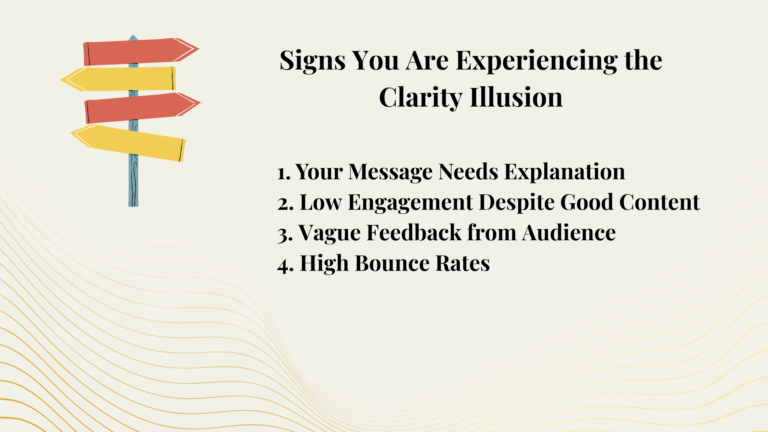
1. Your Message Needs Explanation
If you constantly need to clarify your offer, it’s not clear.
2. Low Engagement Despite Good Content
People read but don’t respond.
3. Vague Feedback from Audience
Comments like:
- “Sounds interesting.”
- “Can you explain more?”
4. High Bounce Rates
Users leave quickly because they don’t understand your value.
Section – 08
How to Fix the Clarity Illusion
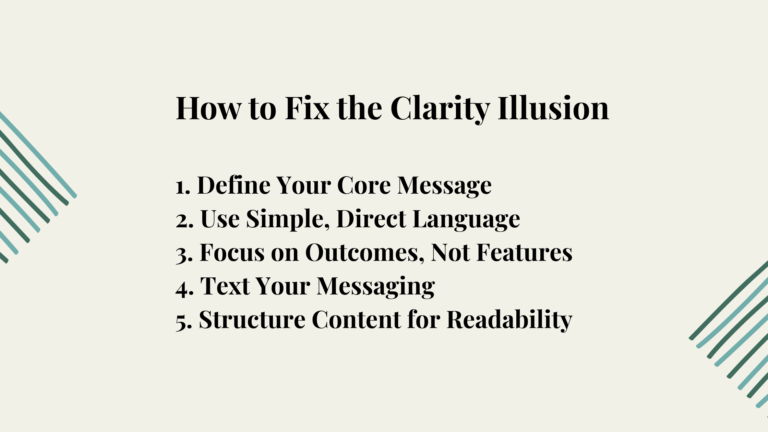
1. Define Your Core Message
Your audience should understand:
- what you do
- who it’s for
- why it matters
Within seconds.
2. Use Simple, Direct Language
Avoid:
- jargon
- complex phrases
- abstract ideas
Clarity beats sophistication.
3. Focus on Outcomes, Not Features
Instead of:
“We provide structured learning modules.”
Say:
“Learn skills that help you get a job.”
4. Text Your Messaging
Ask:
- Can someone explain your message back to you?
- Do they understand it instantly?
If not, simplify further.
5. Structure Content for Readability
Use:
- headings
- short paragraphs
- bullet points
This reduces cognitive load.
Section – 09
Data-Driven Insight: Clarity Improves Conversions
Studies in UX and marketing show:
- Clear messaging can increase conversions significantly
- Simplified content improves user engagement
- Users are more likely to trust easily understood information
For educational platforms, this leads to:
- higher enrollment rates
- better user experience
- increased credibility
Section – 10
Content Strategy for Pakistan and Global Audience
1. Use Accessible Language
Write in simple English and short sentences that work across diverse audiences.
2. Avoid Cultural Assumptions
Keep messaging universally understandable.
3. Focus on Real-Life Outcomes
Relate your message to:
- career growth
- skill development
- practical benefits
4. Build Trust Through Clarity
Clear messaging aligns with Google’s E-E-A-T principles by improving:
- user understanding
- credibility
- authority
Section – 11
People Also Ask (FAQs)
What is the clarity illusion in marketing?
It is when a brand believes its messaging is clear, but the audience finds it confusing or difficult to understand.
Why is clear messaging important?
Clear messaging helps audiences quickly understand your value, increasing trust and conversions.
How do I know if my messaging is unclear?
If users frequently ask questions, show low engagement, or leave quickly, your messaging may lack clarity.
Does clarity affect SEO performance?
Yes. Clear content improves user engagement, reduces bounce rates, and enhances overall SEO performance.
How can I simplify my brand messaging?
Focus on one idea, use simple language, and highlight outcomes instead of features.
What is the biggest mistake in brand messaging?
Assuming your audience understands your message without testing or simplifying it.
Conclusion: Clarity Is Your Competitive Advantage
The clarity illusion is subtle but powerful.
It convinces you that your message is working… even when it’s not.
For educational platforms in Pakistan and beyond, clarity is more than a communication skill. It’s a growth strategy.
Brands that win are not the ones that say more.
They are the ones that are understood faster.
As digital content continues to grow, attention spans will shrink further.
The ability to communicate clearly will become even more valuable.
Because in the end:
If your audience doesn’t understand you, they won’t trust you. And if they don’t trust you, they won’t act.
Pingback: Cognitive Load in Brand Messaging: Why Simplicity Wins