
In today’s world, your audience is overwhelmed before they even land on your website. Because of the saturated information. Every brand is trying to sound “unique.” The result? Confusion, not conversion.
This is the main reason why Cognitive Load Theory becomes a powerful lens for brand messaging.
It originated from educational psychology; this theory explains how humans process information. When you apply this to crafting your brand messaging, it reveals a simple truth:
The easier your message is to understand, the more likely it is to convert.
For businesses in Pakistan and globally, where people use different languages, digital literacy, and attention spans, a simplified message is not optional. It’s a competitive advantage.
Table of Contents
ToggleSection – 02
What Is Cognitive Load Theory?
Cognitive Load Theory explains that the human brain has a limited capacity to process information at any given time.
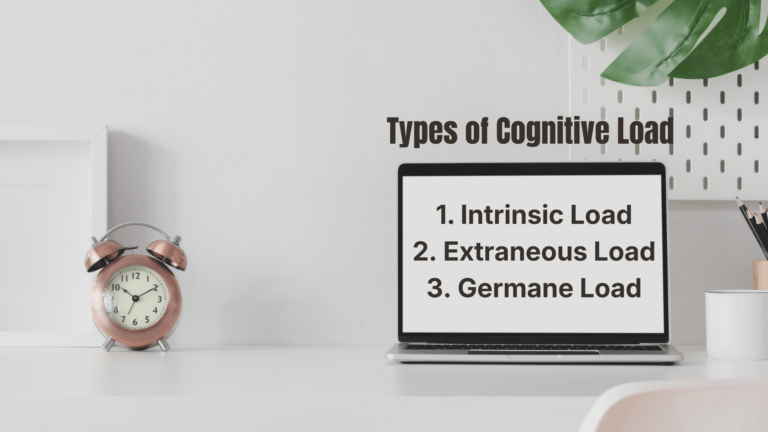
There are the following three types of cognitive load:
1. Intrinsic Load
It means the complexity of the information itself.
Example: Explaining a technical SaaS product to a non-tech.
2. Extraneous Load
How the information is presented to your audience.
Example: Jargon-heavy, cluttered messaging.
3. Germane Load
The mental effort used to understand and keep information.
In brand messaging, your job is simple:
- Reduce extraneous load
- Manage intrinsic load
- Support germane load
In other words, make your brand message easy and simple for your audience.
Section – 03
Why Cognitive Load Directly Impacts Conversions
When users come across complex messaging, three things happen:
- They feel confused
- They lose trust
- They leave immediately
Research about user experience shows that a user forms an opinion about a website in seconds, and clarity is a major factor in whether they stay or leave.
For educational content, this is even more critical. If your audience doesn’t understand your value instantly, they won’t invest time in gathering more confusion.
Section – 04
The Simplicity Advantage in Brand Messaging
Simple messaging is not about being basic. It’s about being strategically clear.
Benefits of low cognitive load messaging:
- Faster understanding
- Higher engagement
- Better retention
- Increment in conversions
In a Pakistani market, where audiences vary in age, interest, and level of understanding. Like students, professionals, and non-native English speakers, simplicity improves the user experience and provide them clarity not confusion.
Section – 05
Common Messaging Mistakes That Increase Cognitive Load
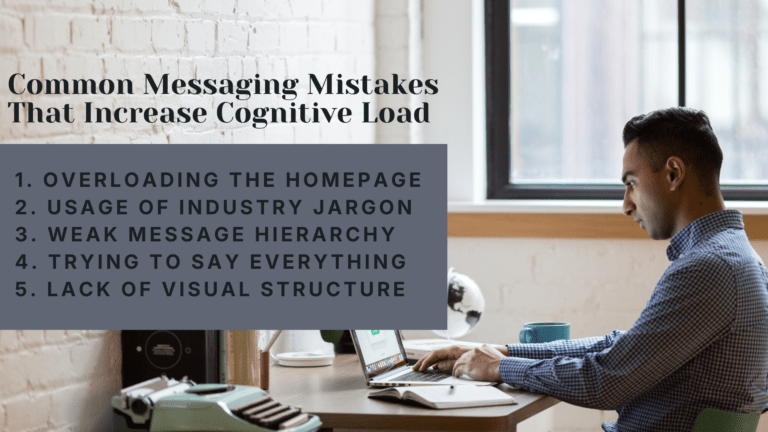
1. Overloading the Homepage
Trying to infuse too many ideas at once.
2. Usage of Industry Jargon
Assuming the audience understands technical language.
3. Weak Message Hierarchy
No clear primary message.
4. Trying to Say Everything
Brands often confuse “comprehensive” with “effective.”
5. Lack of Visual Structure
Dense text without scannability increases friction.
Section – 06
Case Study: Apple’s Simplicity-First Messaging
Apple is the leading example of low cognitive messaging in real-time.
Instead of overcomplicating it for users regarding specifications, Apple uses:
- Clear and short headlines
- Minimal text
- Strong visual support
For example, before every launch, Apple focuses on a single core message, such as performance or design, rather than listing every feature upfront.
Why it works:
- Reduces extraneous load
- Guides attention
- Builds immediate clarity
This approach has contributed to Apple’s consistently high conversion rates and global brand trust.
Explore: The Emotional Granularity in Brand Messaging, Beyond Pain Points
Section – 07
How to Apply Cognitive Load Theory to Your Brand Messaging
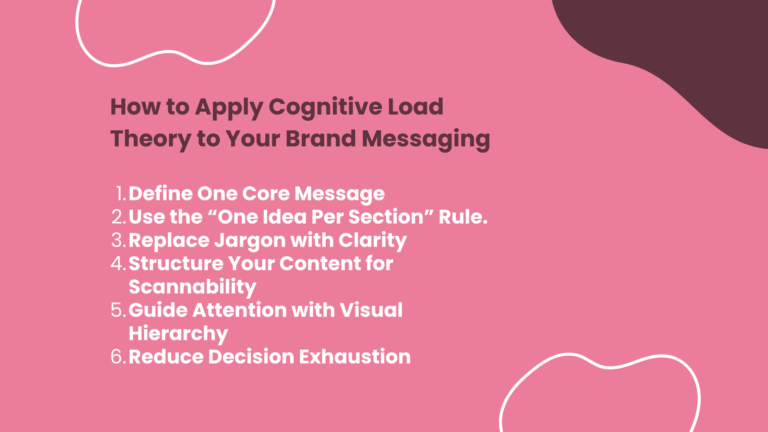
1. Define One Core Message
Your brand should be understandable within 5 seconds to your audience.
Ask:
- What do you do?
- Who is it for?
- Why does it matter?
If you need a paragraph to explain your brand message, it needs simplification now..
2. Use the “One Idea Per Section” Rule
Each section of your website or content should communicate one clear idea.
This reduces mental effort and improves retention.
3. Replace Jargon with Clarity
Instead of:
“Optimized scalable solutions for dynamic growth”
Say:
“Simple systems to help your business grow faster.”
Clarity always builds trust faster than complexity.
4. Structure Your Content for Scannability
Use:
- Headings (H1, H2, H3)strategically
- Bullet points to guide the audience
- Short paragraphs
Most users scan before they read. Make that process effortless.
5. Guide Attention with Visual Hierarchy
Use:
- Bold headlines
- Clear spacing
- Consistent formatting
Your design should simplify your message, not to add visuals only.
6. Reduce Decision exhaustion
Avoid overwhelming your users with too many options at once.
Example:
Instead of 5 CTAs, use only a clear action:
- “Start Learning Today.”
- “Download Free Guide.”
See also: How to Align Founder Personality and Brand Voice for Effective Messaging
Section – 08
Data-Driven Insight: Simplicity Improves Performance
Studies in UX and conversion rate optimization show that:
- Simplified landing pages can increase conversions by up to 30%
- Clear headlines improve engagement significantly
- Users prefer easily digestible content over dense explanations
For educational websites, this translates to:
- Higher course enrollments
- Increased time on site
- Better user retention
Section – 09
Content Strategy for Educational Websites in Pakistan
To apply this effectively:
1. Local + Global Clarity
Use simple English and short sentences that work for both:
- Individuals and business owners from Pakistan
- Global audiences to build trust and authority
2. Contextual Examples
Relate your messaging strategy to real-life examples.
- Career growth
- Skill development
- Academic success
3. Trust Signals
Support your message with:
- Testimonials
- Results
- Case studies
This directly aligns with Google’s E-E-A-T principles:
- Experience
- Expertise
- Authoritativeness
- Trustworthiness
Section -10
People Also Ask (FAQs)
1. What is cognitive load in brand messaging?
Cognitive load in messaging means the mental effort that is required for a user to understand a message. Lower cognitive load leads to better comprehension and high converting rate.
2. Why is simple messaging more effective?
Simple messaging does the three things instantly:
reduces confusion,
builds trust quickly, and
helps users make decisions faster.
3. How do I test if my brand message is clear or not?
Here are the three methods:
You can test clarity through user feedback,
A/B testing, and
by checking if users understand your value within seconds.
4. What is the biggest mistake in brand messaging?
The most common mistake in brand messaging is trying to communicate too many ideas at once, which overwhelms the audience.
5. Does cognitive load affect SEO?
Yes. High cognitive load increases confusion rates and reduces engagement, which negatively impacts SEO performance.
6. How can educational websites reduce cognitive load?
Educational websites can do it by following these simple steps:
By simplifying language,
structuring content clearly, and
focusing on one message at a time.
Conclusion: Simplicity is still your competitive Advantage
Cognitive Load Theory is not just an academic concept. It is a practical framework that can transform how your brand communicates.
In a crowded digital landscape, especially in growing markets like Pakistan, clarity is your strongest differentiator.
Brands that simplify:
- earn trust faster
- communicate value better
- convert more consistently
The future of brand messaging is not louder or more complex. It is clearer, sharper, and easier to understand.
If your audience has to think too hard, they won’t act.
And in business, hesitation is the fastest path to losing attention.
Pingback: The Clarity Illusion in Brand Messaging Explained
Pingback: Mirror Neurons in Brand Messaging: Stories Build Trust - The Brand Clarity GuideMirror Neurons in Brand Messaging: Stories Build Trust
Pingback: Founder Personality vs Brand Voice: When Alignment Fails - The Brand Clarity Guide Founder Personality vs Brand Voice: Alignment Gaps