For months, my services page listed three things: brand messaging, content strategy, and on-page SEO.
Every word was true. I could do all three. And still, something was off — because almost nobody who landed on that page knew which one they actually needed.
If you run a small business or a personal brand in Pakistan or anywhere else, this is worth reading before you write your next services page.
Section – 02
Table of Contents
ToggleThe Problem With Having "Options"
More options feel generous. In practice, they usually confuse people instead.
When a visitor lands on a page with three separate services, their brain has to do extra work before they can act: which one applies to me? Do I need all three? Where do I even start?
Most people don’t do that extra work. They just leave.
This isn’t just a feeling — it’s a well-documented pattern in website usability research. Studies on visitor behavior consistently show that people decide whether to stay or leave a page within the first few seconds, largely based on whether they can tell what you do and whether it’s for them, almost immediately. A page that makes someone stop and think “wait, which one of these applies to me?” has already lost part of its audience before they even start reading.
I didn’t need better writing. I needed fewer, clearer choices.
I used to offer 3 services. Nobody could tell me which one they actually needed. Here’s what happened when I cut it down to 2 — and why fewer options got me clearer inbound leads.
Section – 03
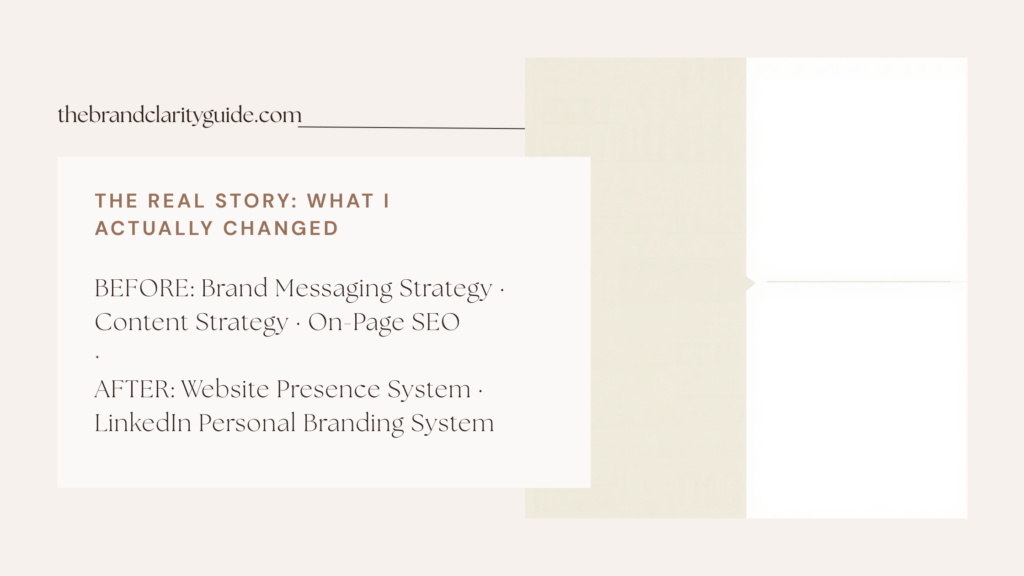
The Real Story: What I Actually Changed
I run The Brand Clarity Guide, a small brand messaging practice based in Pakistan, working with founders and personal brands globally. Here’s exactly what the old structure looked like, and what replaced it.
Before — 3 separate services:
- Brand Messaging Strategy
- Content Strategy
- On-Page SEO
After — 2 clear systems:
- Website Presence System — a full website build, written and structured to say clearly what you do, and built to actually get found in search
- LinkedIn Personal Branding System — a profile and content direction that build trust before you ever say a word
Notice what happened: the old services didn’t disappear. Messaging, content, and SEO are all still part of the work — they just stopped being three separate line items competing for attention, and became the ingredients inside two clear outcomes.
That’s the actual shift. Not doing less. Packaging it around what someone actually walks away with, instead of what skills went into building it.
Section – 04
Case Study: Brandly.pk and the Messaging-First Lesson
Before building this positioning, I worked as a content and copywriting intern at Brandly.pk, an e-commerce brand. Writing blogs, product descriptions, and marketing copy across a wide range of tones taught me something that stuck: the brands that actually converted weren’t the ones producing the most content.
They were the ones with a clear message underneath everything they published.
That single observation became the foundation for how I eventually rebuilt my own services. Not “write more.” Not “offer more skills.” Get the underlying message right first, then build the specific, packaged outcome around it.
Section – 05
Why Fewer Options Actually Convert Better
This isn’t just a personal preference. It reflects a well-known pattern in how people make decisions when faced with too many similar-looking choices: more options increase hesitation, not confidence. When everything looks like a reasonable choice, people often choose nothing at all.
A visitor comparing three abstract service names has to figure out the difference themselves. A visitor comparing two named systems, each with an obvious outcome, can decide in seconds.
Clarity isn’t about simplifying what you know. It’s about simplifying what someone else has to understand before they trust you.
Section – 06
How to Apply This to Your Own Services Page
If your own services page currently lists more than 2-3 offers, try this:
- List everything you currently offer, exactly as it’s written now.
- Group by outcome, not by skill. Ask: what does the client actually walk away with, not what did I technically do to get them there?
- Cut to 2, at most 3, named systems or packages.
- Move the old service names inside each package as “what’s included,” not as separate headline offers.
- Test it on someone unfamiliar with your business. If they can tell you in one sentence what each package is for, it’s working.
Section – 07
Conclusion: Clarity Compounds
Cutting from 3 services to 2 didn’t make my business smaller. It made it easier to say yes to — because there was finally only one real decision left for someone to make: does this sound like what I need, yes or no.
As more founders and small brands compete for the same attention online, this gap will only get more expensive to ignore. The businesses that win aren’t always the ones doing the most. They’re the ones that are the easiest to understand in the first five seconds.
If your own offer still reads like a list of skills instead of a clear outcome, that’s usually the first thing worth fixing — before the website redesign, before the new content calendar, before anything else.
Section – 08
People Also Ask
Should a small business offer multiple services or focus on one?
Focusing on 2-3 clearly named packages, rather than a long list of individual services, generally helps visitors understand and choose faster than an open-ended list of skills.
How many services should I list on my website?
There’s no fixed number, but 2-3 clearly outcome-focused packages tend to convert better than 5+ individual service listings, especially for solo founders and small brands.
What is the difference between a service and a system?
A service usually describes a skill (like “content writing”). A system describes an outcome someone walks away with (like “a website that gets found and understood”). Systems are easier for visitors to evaluate quickly.
Does simplifying my services page hurt my SEO?
Not if handled correctly. Keeping detailed category or blog content around your specific skills (messaging, SEO, content strategy) while presenting simplified packages on your services page lets you keep search visibility for specific terms while still offering a clear, simple choice to visitors.
How do I know if my services page is too confusing?
Ask someone unfamiliar with your business to look at it for five seconds, then explain back to you what you offer and who it’s for. If they can’t, the page needs simplifying.