You have a business.
You have a story.
You might even have a few posts published somewhere online.
But something isn’t clicking.
The audience isn’t growing. The brand doesn’t feel cohesive. And every time you sit down to create content, you stare at a blank screen wondering what to say.
Here’s what’s actually happening:
You don’t have a content problem. You have a strategy problem.
This guide is built specifically for founders and personal brand owners in Pakistan who are starting from scratch or starting over. No fluff. No generic advice copied from a Western marketing textbook. Just a clear, honest framework you can actually use.
Every founder in Pakistan has something worth saying. Most never get heard — not because their story isn’t good, but because they never built a strategy around it. This guide changes that.
Section – 02
Table of Contents
ToggleWhy Pakistani Founders Need a Different Content Strategy Playbook
Most content strategy advice online was written for US or European markets.
It assumes you have a design budget. A content team. A large existing audience. Established brand recognition. Access to the same platforms with the same algorithm behavior.
None of that maps cleanly onto the reality of building a brand in Pakistan in 2024.
Here, the challenges are different:
- Most professional niches are still unclaimed online
- Audiences expect authenticity, not polished corporate content
- Language choices (English, Urdu, or both) are a real strategic decision
- Platform behavior differs. WhatsApp is a conversion channel, not just a messaging app
- Trust is built through consistency and specificity, not through production quality
These differences aren’t obstacles. There are advantages if your strategy accounts for them.
Pakistan’s digital economy is growing fast. The freelance sector alone crossed $397 million in annual exports in recent years. The startup ecosystem is producing more founder voices than ever. And across LinkedIn, Instagram, and YouTube, Pakistani creators are building real audiences from scratch.
But most founders still treat content as an afterthought. They post when they have time. They stop when they get busy. They never build a brand — just a scattered digital footprint.
That gap is exactly where your opportunity lives.
Section – 03
What Content Strategy Actually Means for a Founder
Let’s clear something up before we go further.
Content strategy is not a content calendar.
It’s not a posting schedule. It’s not a list of topics. It’s not even a social media plan.
Content strategy is a set of decisions you make before you create anything.
It answers four questions:
- Who am I talking to?
- What do I want to be known for?
- What will I consistently say and what will I never say?
- How does my content connect to my actual business goals?
Once those questions are answered, everything downstream gets easier. Topics become obvious. Formats become clear. Posting feels purposeful instead of pressured.
Without those answers, content creation is guesswork. And guesswork produces inconsistency. And inconsistency is what kills personal brands before they ever gain traction.
A content strategy doesn’t restrict you. It frees you — because you always know what to say next.
Related: Learn the core difference between content marketing and content strategy
Section – 04
The Four Pillars of a Founder Content Strategy
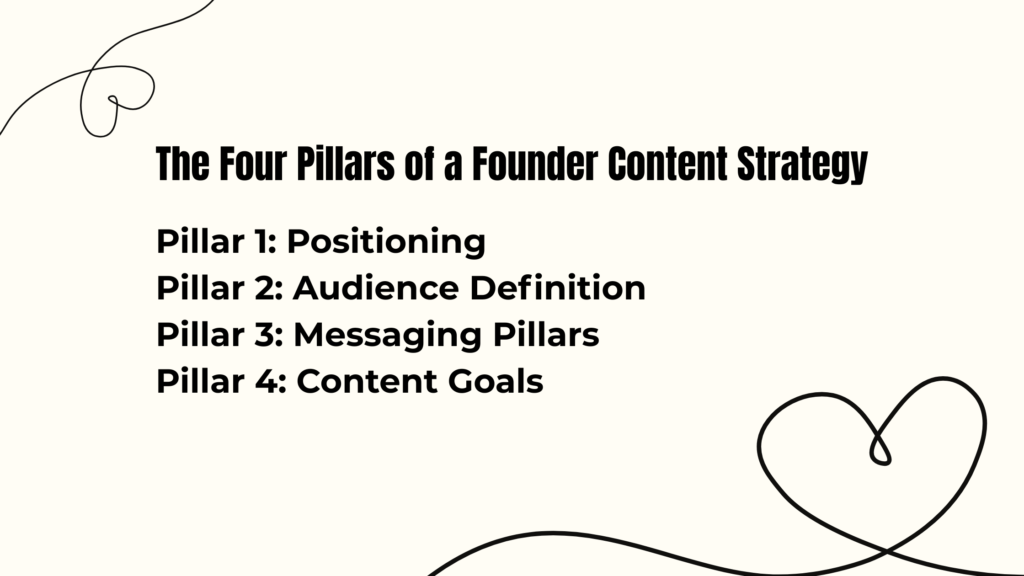
Think of your content strategy as a four-layer foundation. Each layer supports everything built on top of it.
Pillar 1: Positioning
Positioning is the answer to: What do you want your name to stand for?
Not everything you do. Not your full CV. One clear, specific thing.
The more specific your positioning, the faster your brand builds. “I help founders grow” is too broad. “I help Pakistani ecommerce founders build brand authority through content strategy” is a positioning.
Write yours in one sentence. This becomes your filter for every content decision you make.
Pillar 2: Audience Definition
You cannot build a brand for everyone.
The founders who try to reach everyone end up resonating with no one. Define your audience with enough specificity that you can picture one real person reading your content.
Ask yourself:
- What stage of business are they at?
- What keeps them up at night?
- What have they already tried that hasn’t worked?
- What do they search for when they need help?
Your content should make that person feel like you wrote it specifically for them.
Pillar 3: Messaging Pillars
Messaging pillars are the 3 to 5 topics your brand consistently returns to.
They’re not random. They connect directly to your positioning and prove your expertise over time. Every post, article, or video you create belongs to one of these pillars.
This is what creates a pattern. And the pattern is what makes a brand recognizable.
For a founder in the content and personal brand space, pillars might look like:
- Content strategy frameworks
- Brand positioning for founders
- Lessons from real founder experiences
- Pakistan-specific market insights
- Common mistakes and how to fix them
Pillar 4: Content Goals
Every piece of content should have a job.
Some content builds awareness — it introduces your brand to new people. Some content builds trust — it shows depth, expertise, and honesty. Some content drives action — it moves someone toward a purchase, a booking, or a conversation.
A healthy content strategy includes all three types. Not every post needs to sell. But every post should serve a purpose within a bigger brand-building goal.
Related: Content strategy vs. content marketing: what founders must know
Section – 05
A Real Example: Amna Hafeez and the Power of Niche Positioning in Pakistan
Amna Hafeez built one of Pakistan’s most recognizable personal brands in the HR and career development space — not through a large budget, but through ruthlessly consistent positioning.
Her content on LinkedIn stayed inside a clearly defined lane: career advice for Pakistani professionals, grounded in real local market context rather than generic global tips. She spoke to a specific audience, used language that felt familiar and honest, and returned to the same themes week after week.
The result was a following that trusted her — because she was predictable in the best way. Her audience knew exactly what they’d get from her content. That consistency converted into speaking invitations, consulting opportunities, and brand partnerships.
The lesson for founders: you don’t need to be famous before you start. You need to be specific. Specificity creates trust. Trust creates an audience. An audience creates opportunity.
Section – 06
Platform Strategy: Where Should Pakistani Founders Focus?
You cannot — and should not — be everywhere at once.
Here’s a simple framework for choosing your primary platform:
| Audience Type | Best Platform |
|---|---|
| B2B, investors, professionals | |
| Consumer brands, lifestyle, fashion | |
| Educators, storytellers, long-form | YouTube |
| Real-time conversations, tech founders | X (Twitter) |
| Local community, warm leads |
Pick one primary platform. Build your presence there first. Only expand to a second platform once you have a consistent, sustainable cadence on your first.
One platform done well beats five platforms done poorly.
A note on WhatsApp: this platform is dramatically underused as a founder content and conversion channel in Pakistan. A well-managed WhatsApp broadcast list — with consistent, value-first content — can be more effective than an Instagram page three times its size, because the relationship is direct and the trust level is higher.
Section – 07
The Language Decision: English, Urdu, or Both?
This question comes up in every conversation about Pakistani founder content. And it deserves a real answer.
There is no universally correct choice.
The right language choice depends on your audience, your positioning, and your platform.
English works well for B2B contexts, investor-facing content, and international audiences. Urdu builds stronger emotional connection with local audiences, especially in consumer categories.
But here’s the underused option: intentional code-switching.
Many of the strongest Pakistani founder voices online mix both languages naturally — the way they actually think and talk. This isn’t unprofessional. When done intentionally, it’s a brand asset. It signals authenticity. It makes your content feel human rather than corporate.
The key word is intentional. Random language switching looks uncertain. Consistent, deliberate mixing that reflects your genuine voice looks like a brand choice. Because it is one.
Section – 08
How to Start When You Have No Audience and No Budget
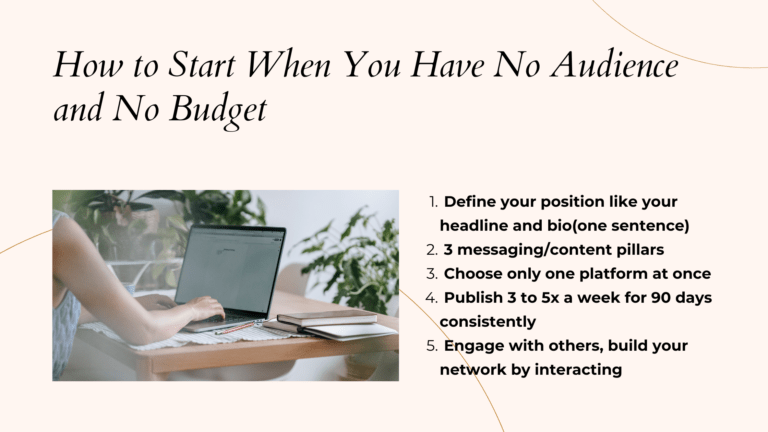
Step 1: Write your positioning statement. One sentence. Who you help, what you help them with, and your unique angle.
Step 2: Define three messaging pillars. The three topics your brand will own.
Step 3: Choose one platform. Based on your audience — not on trends.
Step 4: Publish three pieces of content per week for 90 days. One post per pillar, rotating.
Step 5: Engage before you expect engagement. Comment on others’ posts before you expect others to comment on yours.
That’s it.
No budget required. No team required. No existing audience required.
What’s required is clarity and consistency — and both of those are free.
The founders who build the strongest brands don’t start with the most resources. They start with the clearest positioning.
Section – 09
FAQS (Frequently Asked Questions)
1. Do I need a registered business before building a personal brand in Pakistan?
No. A personal brand is built around your name and expertise — not a company structure. Many of Pakistan’s strongest founder voices built their personal brand before (or instead of) building a formal company. Your credibility comes from your content and positioning, not from a registration certificate.
2. How long does it take to build a personal brand from scratch in Pakistan?
Realistically, 3 to 6 months of consistent, positioned content before you start seeing compounding results. The first 90 days feel slow. Most people quit here. The founders who stay consistent past this point are the ones who build real brand equity.
3. Should I hire someone to write my content for me?
Not at the start. Your personal brand needs to sound like you — especially in the early stages when your audience is deciding whether to trust you. You can bring in help for editing, design, or scheduling later. But the voice, the ideas, and the positioning need to be genuinely yours.
4. What’s the biggest mistake Pakistani founders make with content?
Starting with the platform instead of the positioning. Choosing Instagram or LinkedIn first, then trying to figure out what to say, produces generic content that looks like everyone else. Decide what you stand for first. Then decide where to say it.
5. Can I build a personal brand as a founder if I’m also running a business full-time?
Yes — but you need to be realistic about cadence. Two to three well-positioned posts per week is more than enough to build a brand over time. The mistake is trying to post daily and burning out at week three. Consistency over months beats intensity over weeks.
6. Is personal branding only for founders with “big” stories?
No. The strongest personal brands in Pakistan aren’t built on extraordinary stories. They’re built on specific, honest, consistent ones. Your experience as a founder navigating your actual market — with your actual constraints — is more valuable to your audience than a polished success narrative.
7. What should my very first piece of content be?
Your positioning post. Tell your audience who you are, who you help, and what you’ll consistently talk about. Be specific. This sets expectations from day one and attracts the right followers before you’ve published anything else.
Conclusion: Pakistan's Next Wave of Founder Brands Starts With a Strategy
The Pakistani founder ecosystem is at an inflection point.
More founders are online than ever before. More platforms are accessible. More audiences are ready to follow voices they trust.
But most of the digital space is still unclaimed. Most niches still have no dominant founder voice. Most categories are waiting for someone to show up clearly and consistently enough to own them.
That someone can be you.
Not because you have the most experience. Not because you have the best production setup. But because you’re willing to do what most founders skip: build the strategy layer first, before you post a single word.
Positioning. Messaging pillars. Audience clarity. Platform focus. Language intention.
These are the decisions that separate founders who get remembered from founders who just get seen.
Start with strategy. Everything else follows.
Looking ahead: Pakistan’s creator economy is growing faster than the infrastructure to support it. The founders who build audiences now — through genuine, positioned, consistent content — will have a head start that money can’t easily buy later. The window is open. The category is yours to define.